Event weather insurance can transfer defined financial losses, but only when the exposure, trigger, mitigation plan and evidence match the policy wording.
Event weather insurance is coverage designed to protect specified financial interests when defined weather conditions cause an insured event to be cancelled, postponed, interrupted, curtailed or relocated. The important words are specified, defined and insured: a forecast, a wet site or a disappointed audience does not automatically create a covered loss.
For concert and festival teams, weather therefore creates two connected but different decisions. The first is whether the event can proceed safely. The second is whether the resulting financial loss falls within the policy actually purchased. A disciplined plan keeps those decisions aligned without allowing an insurance assumption to delay a safety action.
This guide is an operating framework, not insurance, legal, meteorological or safety advice. Coverage varies by market, insurer, wording, event, hazard and purchase date. Use a qualified broker, insurer, local weather professional, safety lead and legal adviser for the actual decision.
What does event weather insurance cover?
It covers only the weather perils, event consequences, costs, revenue interests, periods and limits stated in the policy. The Insurance Information Institute’s special-event overview describes cancellation protection for circumstances outside the organiser’s control, including some adverse weather and natural disasters. That high-level description is not a substitute for policy wording.
An Allianz event-cancellation product information document, for example, lists adverse weather and open-air events among base exclusions while showing adverse weather as a possible extension. The lesson is not that every policy excludes weather. It is that a familiar product name can conceal a decisive difference in the schedule or endorsement.
“Weather covered” is not a useful buying conclusion until the peril, consequence, trigger, period and insured loss are written down.
Separate the safety plan from the financial plan
NOAA says a lightning safety plan should be part of outdoor-event planning long before a storm develops. Its large-group guidance asks organisers to identify safe locations, understand evacuation time, monitor conditions and communicate the plan to the event team.
Insurance does not perform any of those jobs. It may protect an agreed financial interest after a covered decision; it does not decide when a stage, field or temporary structure is safe. Build the weather action plan with named operational authority, then make sure the insurance placement understands that plan and its decision thresholds.
WENOTIFT’s festival heat-safety playbook maps the site, water, shade and medical decisions required for hot conditions. The insurance conversation should follow the same risk register, but coverage and safety controls must remain separate workstreams.
The six-part Weather-to-Claim Chain
This Weather-to-Claim Chain is a WENOTIFT operating framework, not an insurer’s coverage test. It is designed to expose a gap—such as a weather peril with no extension or a decision threshold with no evidence owner—before the event budget depends on it.
Build the exposure map before asking for a quote
Start with the event rather than the insurance form. List the build, rehearsal, show, dismantle and travel periods; each location; outdoor or temporary structures; audience and crew capacity; critical performers and suppliers; and the weather hazards that could affect each phase.
Then create a value schedule. Separate non-recoverable costs already committed, additional expenses that could preserve the show, expected revenue interests, refunds, supplier liabilities and any contractual amounts owed after a disruption. Do not assume every line is insurable. The purpose is to let the broker and underwriter see the financial architecture clearly enough to accept, exclude or qualify it.
The event’s contracts should tell the same story. WENOTIFT’s artist booking contract checklist explains why cancellation, force-majeure, production and payment responsibilities must be explicit. Insurance cannot repair a contract that assigns an unexpected cost to the wrong party.
Compare policy wording, not product labels
| Decision point | Question to resolve | Evidence to request | Risk of leaving it vague |
|---|---|---|---|
| Covered weather | Which perils and conditions are included or excluded? | Schedule, definitions and endorsements | The actual hazard sits outside cover |
| Covered consequence | Must the event be cancelled, or are postponement, relocation, interruption and curtailment included? | Insuring clause and defined terms | A workable alternative changes claim treatment |
| Trigger and authority | What makes the action necessary, and whose decision counts? | Trigger wording and authority requirements | A reasonable operational decision does not meet the policy test |
| Insured value | Which costs, revenue interests and additional expenses are covered? | Declared-value schedule and sublimits | The team expects recovery for an undeclared line |
| Timing | When must cover attach, and what known circumstances are excluded? | Inception date and known-circumstance language | A forecast or developing condition predates cover |
| Duties | What monitoring, protection, notification and loss-mitigation duties apply? | Conditions and claims protocol | A preventable process failure complicates recovery |
Ask the broker to walk through realistic scenarios in writing: unsafe wind during build, lightning before doors, flooding that blocks access, heat that requires curtailed programming, a weather-damaged temporary structure, or a relocation that preserves part of the audience. A scenario answer is still subject to the final wording, but it reveals mismatched assumptions early.
Connect weather authority to a timed decision log
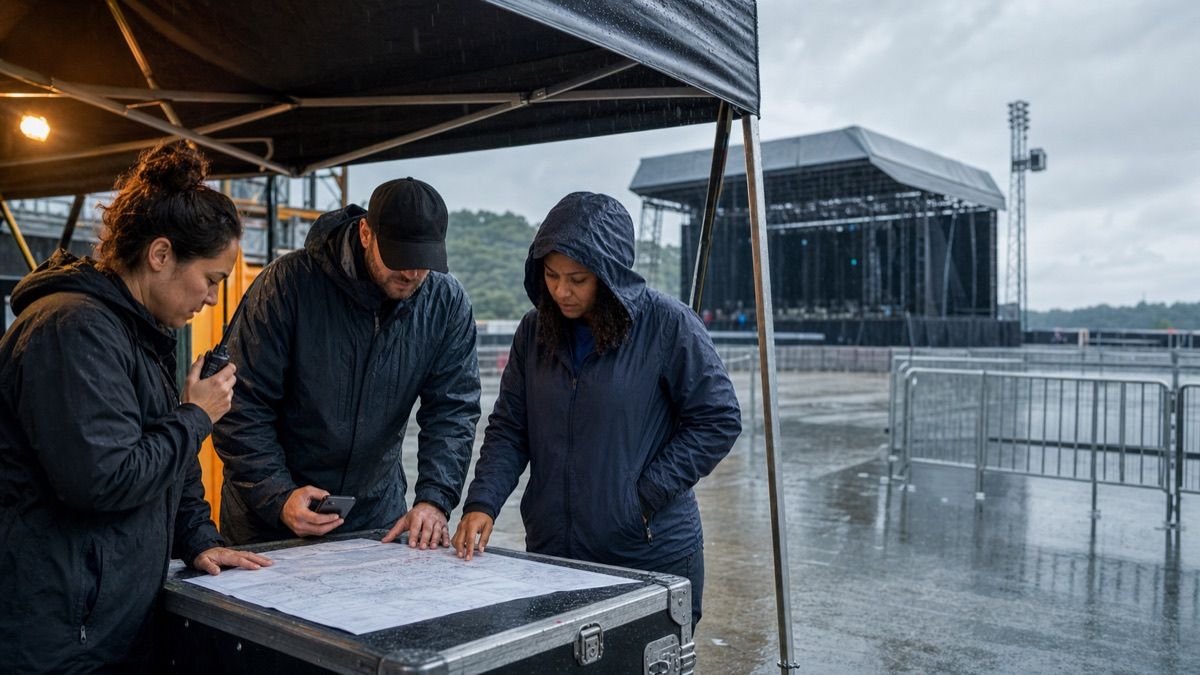
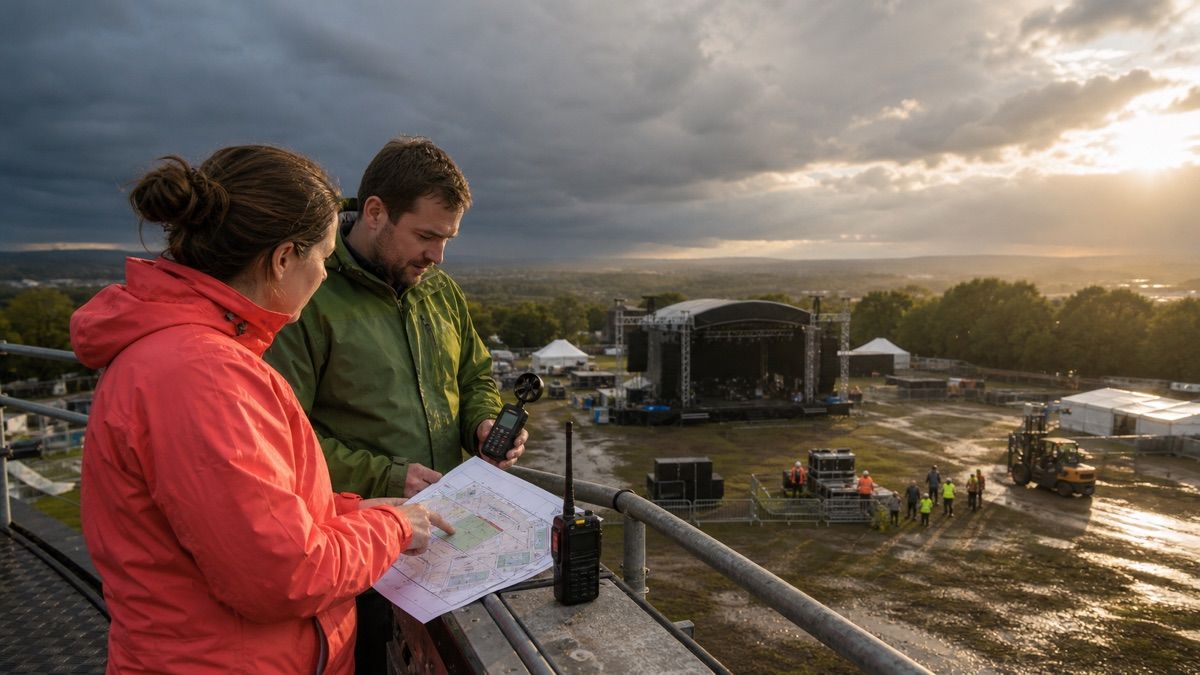
A weather plan needs one monitoring source, one qualified interpretation path and one clearly authorised decision structure. Avoid a group chat in which production, security, artist management and the venue each believe somebody else can stop the show.
NOAA’s 2025 study of 16,232 large outdoor gatherings across 477 US venues found that potential lightning and tornado exposure changes by place, month and event type. The finding supports a location- and date-specific assessment; it does not provide a universal trigger for any individual event.
Write the decision timeline before show day: routine monitoring frequency, escalation points, who receives alerts, the latest viable relocation or postponement time, the evacuation lead time, the decision authority and the communication owner. When the plan activates, log timestamps, information sources, observed conditions, advice received, the decision and the actions taken.
Preserve the claim file while the event is still moving
Do not wait for the final loss calculation to begin evidence collection. Keep the current policy, schedule and endorsements with the exposure register, supplier and talent contracts, budget, ticket and refund records, weather reports, site photographs, safety logs, decision record, audience communications, invoices and evidence of mitigation.
Notify through the required channel and within the stated period. Track additional expenses separately from the original budget and record why they were necessary. If relocation, delay or partial operation reduces the loss, preserve that evidence too.
WENOTIFT’s concert cancellation communications plan covers the fan-facing sequence after a show decision. The claim file should retain the same approved messages and timestamps because they help establish what happened and when.
Questions to ask before binding cover
Ask for direct, written answers to these questions:
- Which weather perils and event phases are covered, excluded or available only by extension?
- Are cancellation, postponement, interruption, curtailment and relocation treated differently?
- Which costs, revenues, additional expenses and contractual liabilities are declared?
- What policy trigger and decision authority apply to each scenario?
- What known-circumstance, timing, monitoring, protection and notification conditions apply?
- How do deductibles, sublimits, waiting periods and aggregate limits change the recovery?
- What evidence should the event team capture before, during and after a disruption?
The purpose is not to predict every storm. It is to prevent the finance plan from depending on a coverage assumption nobody has tested.
WENOTIFT is an AI-powered brand-partnership platform — a real-time partnership dashboard that helps teams connect entertainment decisions, operating responsibilities and evidence before execution.
Sources
- NOAA JetStream — Lightning Safety and large-group planning
- NOAA repository — Spatiotemporal Analyses of Lightning and Tornado Exposure to Large Outdoor Gatherings (2025)
- NOAA Climate.gov — Keeping fans safe in a warming world (2025)
- Allianz Commercial — Event Cancellation Insurance product information document (2025)
- Insurance Information Institute — Special event insurance
Connect the weather decision to the financial plan before gates open.
Talk to WENOTIFT about event-risk responsibilities, contract dependencies, decision gates and evidence architecture for live programmes.